ENT specialist
TMJ disorder (temporomandibular disorder)
A TMJ disorder causes jaw pain, clicking and, often, ear pain or tinnitus without infection. Learn the causes, treatment and when to seek advice.
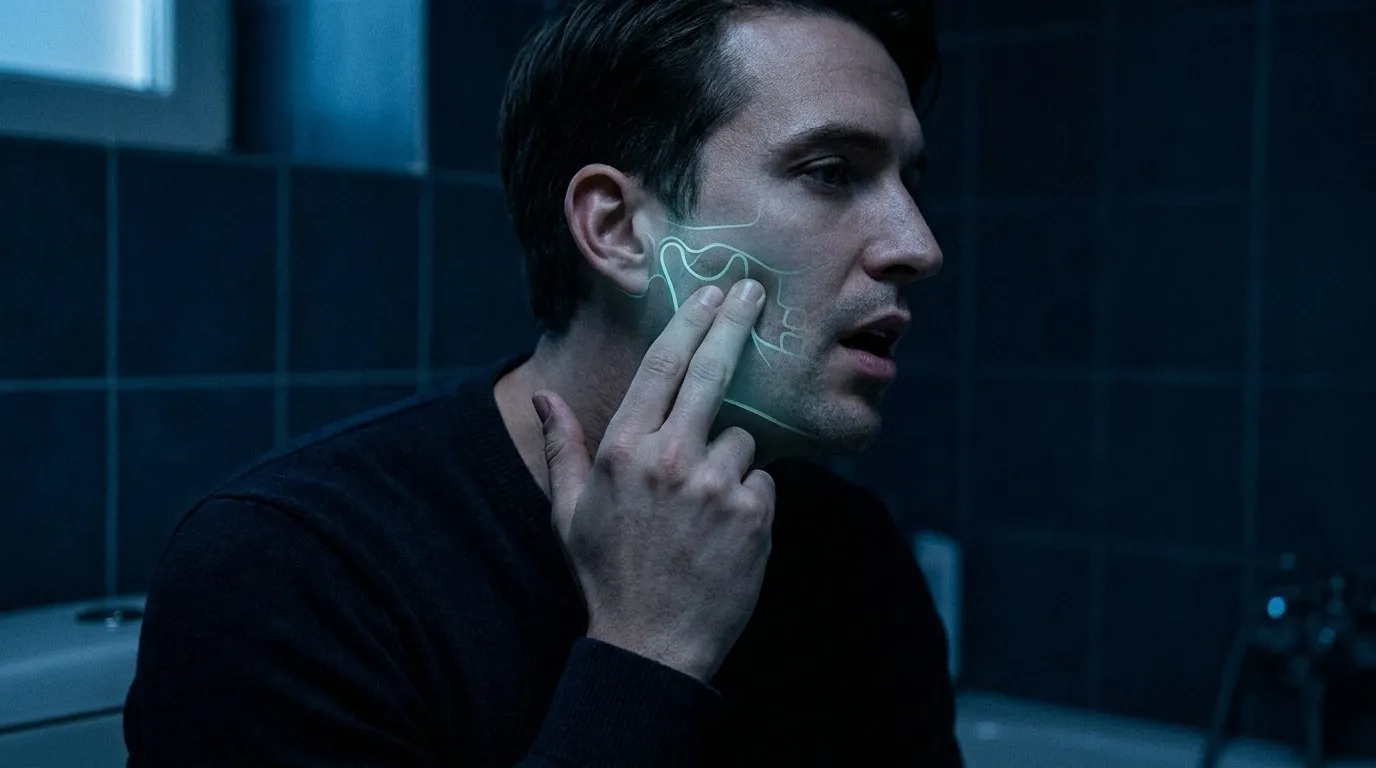
A temporomandibular disorder (TMD), also called a TMJ disorder, affects the joint that connects the jaw to the skull, just in front of the ear, and the chewing muscles. It causes jaw pain, clicking and, quite often, ear pain or a blocked feeling with no infection. It was once known as Costen’s syndrome.
What is a TMJ disorder (Costen’s syndrome)?
The TMJ is the joint that lets you open and close your mouth, chew and speak. It lies right in front of the ear. When the joint or the muscles that move it are overloaded or inflamed, we call it a temporomandibular disorder.
It is common: it affects between 6 and 9 % of adults, mainly women between 20 and 50.
What are the symptoms?
- Pain in the jaw, temple or in front of the ear, worse when chewing or talking.
- Clicking, popping or grating noises when opening and closing the mouth.
- Difficulty opening the mouth fully, or a feeling that it “catches”.
- Headache at the temple and neck tension.
- Ear pain without infection, a blocked-ear feeling or tinnitus (ringing).
- Sometimes dizziness or unsteadiness.
Ear symptoms are common: in one review of studies, more than half of the adults with a TMJ disorder had ear pain and tinnitus, and an even larger proportion had a blocked-ear feeling.
Why does my ear hurt if the problem is in my jaw?
The TMJ lies next to the ear canal. They share nearby nerves: the auriculotemporal nerve, a branch of the trigeminal nerve, supplies the joint and part of the ear canal and eardrum. That is why jaw pain can be felt in the ear. The muscles that move the jaw also influence the blocked-ear feeling.
This is what we call referred pain: the brain reads as ear pain what comes from the joint and muscles.
That is why it is important for an ENT specialist to check your ear and throat before putting the symptoms down to the TMJ, because other causes can also give ear pain.
Why does it happen?
There is no single cause. Several things add up:
- Clenching or grinding the teeth (bruxism), by day or at night.
- Stress and muscle tension.
- Habits: biting nails, chewing gum a lot, resting your chin on your hand.
- Blows to the jaw or opening the mouth very wide (for example, a big yawn or at the dentist).
- Arthritis or problems with the disc in the joint.
- Poor posture of the neck and shoulders.
How is it diagnosed?
Diagnosis is based on your history and an examination:
- Questions about pain, noises, habits and stress.
- Feeling the muscles and the joint, and measuring how far you can open your mouth.
- Examination of the ear, nose and throat, to rule out other causes of pain or fullness.
- Tympanometry or a hearing test if you notice poorer hearing or have tinnitus.
International diagnostic criteria (DC/TMD) are used. Scans (MRI or CT) are requested only if there are doubts or the picture is not typical. They are not needed to start treatment.
How is it treated?
Most people improve with simple, reversible treatments. The latest international guideline, for pain lasting more than three months, strongly recommends:
- Education and self-care: understanding the problem, reassurance and exercises at home. We explain this in TMJ self-care: exercises and advice.
- Jaw and posture exercises guided by a professional.
- Manual therapy (mobilisation, massage of tension points).
- Cognitive behavioural therapy to manage stress and pain.
Painkillers can be used for a short time, as your doctor advises.
The same guideline does not recommend other options: occlusal splints, injections, arthrocentesis and joint surgery. It strongly advises against irreversible splints and disc surgery. These are decisions taken with a dentist. We refer you to a dentist with experience in orofacial pain and, if a more specialised assessment is needed, to a maxillofacial surgeon.
Advice
- Do not put anything in your ear to ease the pain.
- Avoid chewing gum and very hard foods while it hurts.
- Relax your jaw: lips together, teeth apart.
- Do not open your mouth to the maximum when yawning: gently support your chin.
- Apply moist heat to the area.
- Take breaks if you work at a computer and look after your posture.
- Book an appointment if the pain limits you or lasts weeks.
When should I seek urgent help?
Go to A&E or call 112 (in Spain) or your local emergency number if:
- You have sudden hearing loss.
- Your mouth locks and you cannot open or close it.
- There is swelling, fever or redness in front of the ear.
- You are over 50 and have a new headache at the temple, with pain on chewing or vision problems.
- You notice a drooping face.
Book an appointment soon if the ear pain does not improve with these measures, if you have new tinnitus or if you cannot eat normally.
Frequently asked questions
Can a jaw problem cause ear pain? Yes. The joint and the ear share nearby nerves, and jaw pain can be felt in the ear.
Is it serious? Not usually, but it can be very troublesome. Most people improve with treatment.
Does it go away? In many people it improves a great deal. It can return with stress or bruxism.
Is it the same as Costen’s syndrome? Yes. It is the old name for a TMJ disorder.
Do I need a splint? Not always. The latest guidelines do not recommend splints as a first option. The dentist decides.
Do I need an operation? Almost never. Surgery is kept for very specific cases.
Why is my ear ringing? It may be due to tension in the jaw muscles, but the ear needs to be checked to rule out other causes.
References
- Busse JW, Casassus R, Carrasco-Labra A, et al. Management of chronic pain associated with temporomandibular disorders: a clinical practice guideline. BMJ. 2023;383:e076227.
- Schiffman E, Ohrbach R, Truelove E, et al. Diagnostic criteria for temporomandibular disorders (DC/TMD) for clinical and research applications. J Oral Facial Pain Headache. 2014;28(1):6-27.
- Porto De Toledo I, Stefani FM, Porporatti AL, et al. Prevalence of otologic signs and symptoms in adult patients with temporomandibular disorders: a systematic review and meta-analysis. Clin Oral Investig. 2017;21(2):597-605.
For general information only. It does not replace a medical consultation and cannot be used for diagnosis. In an emergency in Spain, call 112.